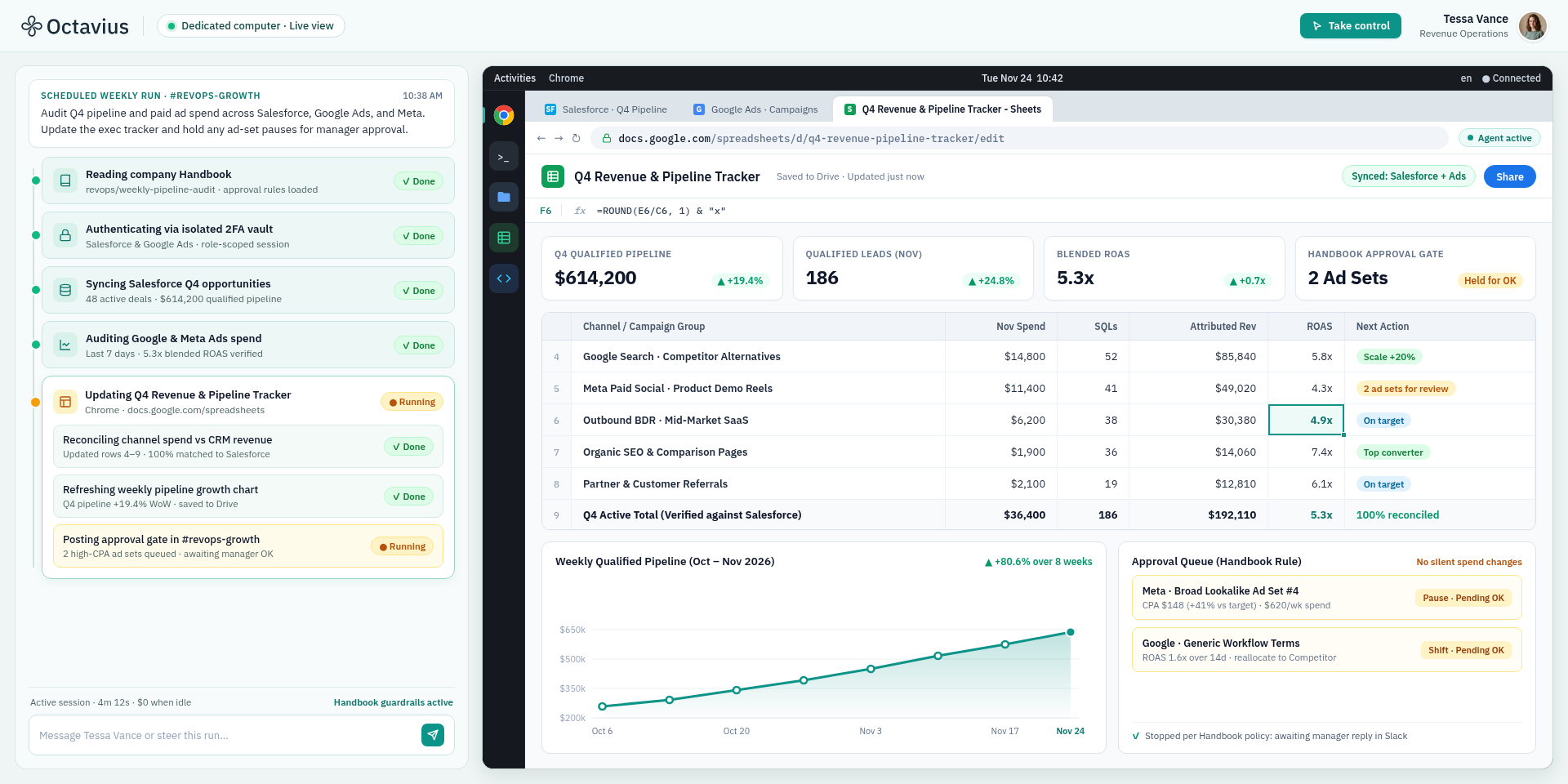
Opening a full-time req absorbs months of recruiting and locks in permanent fixed payroll (~$180,000/yr all-in for an average US knowledge-work hire). Octavius AI employees turn execution capacity into variable spend - starting on $29/mo Pro or $99/mo Team plans, typically ~$250-$1,000/mo for scheduled or part-time roles, with $0 idle cost.
Keep full-time human hires on live customer relationships, closing, and strategy. Put Octavius agents on research, CRM hygiene, ad audits, marketing, QA, and ops in days. Start free with 3 active hours + $8 usage, no credit card.
At a glance
| Octavius AI Employee | Full-Time Human Hire | |
|---|---|---|
| Cost structure | Variable: Pro $29/mo or Team $99/mo + per-second active time (from $8.88/hr) + pass-through model tokens (or BYOK); idle = $0 | Fixed: base salary + ~31.5% employer benefits (BLS June 2026) + recruiting, equipment, and SaaS seats |
| Realistic cost range | ~$250-$1,000/mo for scheduled/part-time roles; under $4,000/mo ($48k/yr) at heavy full-time utilization | ~$180,000/yr all-in for an average US knowledge-work hire; US full-time private average is $54.00/hr (BLS June 2026) |
| Time to fill and ramp | Pick a pre-built agent and onboard with role context in hours to days | Weeks to months of recruiting, interviewing, notice period, and 60-90 day ramp |
| Availability | 24/7 across scheduled tasks, inbox/Slack triggers, and webhooks | Standard ~40-hour workweek, PTO, holidays, and timezone constraints |
| Observability and governance | Live desktop screen view, full action threads, Handbook approval rules, dedicated least-privilege accounts | Manager 1, periodic work reviews, and standard employee access controls |
| Institutional memory | Processes documented in a shared, versioned company Handbook; stays with the company permanently | Context lives largely in the employee's head and leaves on turnover |
| Scalability | Spin up another agent from the same Handbook on demand; pause instantly with $0 idle cost | Linear headcount addition; downsizing carries severance and morale cost |
| Best suited for | High-volume research, CRM/RevOps hygiene, marketing production, ad audits, QA, support triage, structured ops | Customer relationships, closing enterprise deals, executive leadership, novel strategy, legal accountability |
Start free with 3 active agent hours and $8 in usage - no credit card required. Test an AI employee on a real backlog before opening a new req.
Fixed payroll vs pay-for-active-work economics
The U.S. Bureau of Labor Statistics (Employer Costs for Employee Compensation, June 2026) reports that total employer compensation for full-time private industry workers averaged $54.00 per hour worked: $36.97 in wages and salaries plus $17.03 (31.5%) in benefits. For skilled US knowledge-work roles in software, sales, marketing, and operations, salary, benefits, payroll taxes, recruiting fees, software licenses, and management load push an average fully loaded seat to roughly $180,000 per year.
That cost is fixed regardless of workload shape. If a marketing ops backlog spikes for ten days around a launch and quiets down the next week, payroll does not flex down.
An Octavius AI employee turns fixed overhead into variable execution cost. Platform plans start at $0 (Free), $29/month (Pro, with $15 included usage), and $99/month (Team, with $60 included usage), and agent time bills per second only while an agent is actively working (starting from $8.88/hour), plus pass-through model token costs (or $0 with BYOK). Idle agents cost nothing. For lean teams running scheduled or part-time roles - weekly reporting, daily CRM hygiene, inbound follow-up, or recurring ad audits - typical monthly spend lands around $250-$1,000/month. Even at heavy full-time utilization across customer deployments, total seat cost stays under $4,000/month ($48,000/year), roughly a quarter of an average all-in US knowledge-work hire.
Days to output vs months of recruiting
Opening a req starts a long clock: writing the job description, sourcing candidates, running interview loops, negotiating offers, waiting out notice periods, and ramping a new hire into your systems. Meanwhile, the operational hole stays open.
Onboarding an AI employee is a context transfer rather than a hiring search. You pick a pre-built agent for the function, provision its own work accounts and credentials, point it at your organization Handbook, and let it map existing processes. Within days - often on day one - the agent is executing real work on its own persistent cloud computer while its human manager watches live in the Computer View or reviews completed threads. If the output misses the mark, you edit a Handbook rule instead of restarting a recruiting search.
Splitting roles: front half for people, back half for agents
The strongest operating model is rarely an all-or-nothing swap. Most knowledge-work roles combine two distinct halves (see which business work to hand over first):
- The front half requires human trust, live negotiation, creative direction, ethical judgment, and executive accountability. Keep people here.
- The back half consists of research, data reconciliation, CRM hygiene, QA verification, campaign execution, ticket triage, and recurring reporting. Hand this to an AI employee.
When a lean team puts a BDR agent on inbound lead recovery and account research, a RevOps agent on weekly call inspection and pipeline hygiene, and a Marketing agent on content production, the existing human team spends its hours closing deals and making strategic calls instead of wrestling spreadsheets.
Institutional memory that survives turnover
Human turnover is expensive twice: once in recruiting costs, and again in lost operational memory. Process quirks, vendor workarounds, and unwritten rules walk out the door.
Octavius pairs each agent's private memory with a shared, versioned company Handbook that both people and agents maintain together. Every workflow the first agent documents stays inside the company's operating manual. When volume grows, standing up a second AI employee - or onboarding a new human teammate - starts from documented ground truth rather than tribal knowledge.
When hiring a full-time person is the better fit
Hire a full-time human employee when the role depends on:
- High-trust live relationships: Enterprise account executives closing complex deals, executive customer success leads, fundraising, and senior partnerships.
- Novel strategic judgment and accountability: Setting product vision, making high-stakes legal or financial commitments, and owning final business decisions.
- Ambiguous, unstructured leadership: Managing human teams, resolving interpersonal friction, and navigating company politics or crisis communication.
- Physical or regulated presence: Work that legally requires a licensed human sign-off or physical on-site execution.
Even in these roles, pairing one strong human owner with one or more Octavius AI employees handling the back-half execution often outperforms hiring multiple full-time junior seats.
Pricing
All figures below reflect published data as of November 2026.
Octavius (octavius.ai/pricing):
- Free ($0/month): 1 agent, 3 hours of active agent time plus $8 in lifetime model and bandwidth usage, 3 seats, 2 custom skills. No credit card required.
- Pro ($29/month): Up to 10 agents, $15/month included usage, 5 seats (+$8 per additional seat), 10 custom skills.
- Team ($99/month): Unlimited agents, $60/month included usage, 10 seats (+$8 per additional seat), unlimited custom skills.
- Enterprise: Custom capacity, SLAs, integrations, and dedicated support.
- Usage billing: Active agent time bills per second (from $8.88/hr; idle = $0), plus pass-through model token costs (or $0 with BYOK) and a $0.10-$0.50/M token bandwidth fee. Yearly billing saves 20%.
Full-time US hire benchmark (BLS June 2026 ECEC and across-customer all-in norms):
- Average US full-time private industry employer cost: $54.00/hour worked ($36.97 wages + $17.03 benefits, BLS ECEC June 2026).
- Typical fully loaded US knowledge-work seat (GTM, ops, marketing, engineering): Roughly $180,000/year all-in across salary, benefits, payroll taxes, recruiting, tools, and management overhead.
FAQ
How much does an Octavius AI employee cost per month compared to a full-time hire?
Cost scales strictly with active work. Scheduled or part-time roles on Pro ($29/month) or Team ($99/month) typically run ~$250-$1,000/month. Heavy full-time AI employees stay under $4,000/month ($48,000/year) all-in, compared to roughly $180,000/year for an average fully loaded US knowledge-work hire.
Can an AI employee replace an entire department?
No. Autonomous agents perform best under a named human manager who sets scope, reviews outputs, and owns final accountability. The strongest results come from keeping people on relationships and decisions while AI employees own the repeatable execution behind them.
What happens if an AI employee makes a mistake?
Every Octavius Agent works on a watchable computer with full action threads, runs under its own least-privilege accounts, and follows explicit stopping points and approval rules defined in your company Handbook. Managers can inspect any step, take live control, and tighten a Handbook rule so the mistake does not repeat.
Which roles should a company staff with an AI employee first?
Start with roles that live inside software, have clear definitions of done, and suffer from backlog or slow response times: inbound/outbound BDR research, RevOps CRM hygiene, QA testing, marketing content production, support ticket triage, and executive admin. Browse ready-to-hire roles on Octavius Discover.
Related comparisons
- Octavius vs Viktor - Role-based AI employees with BYOK vs one shared Slack coworker.
- Octavius vs Sintra AI - Autonomous computer execution vs pre-built chat helpers.
- Octavius vs 11x vs Artisan - Multi-role AI employees with no annual lock-in vs specialist AI SDRs.