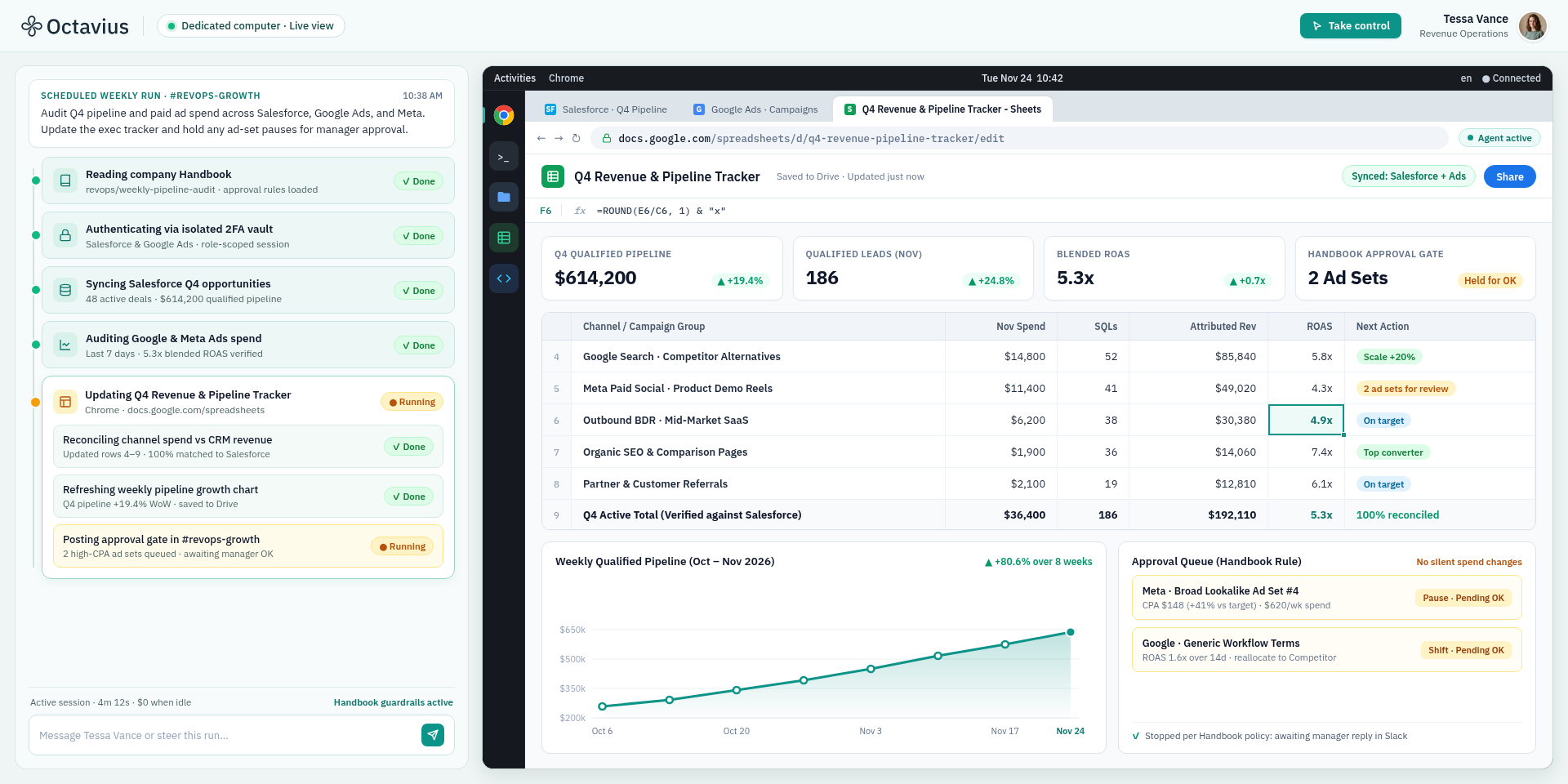
Teams comparing Octavius and OpenClaw are choosing between managed AI employees and a self-hosted open-source gateway. OpenClaw (MIT-licensed, by the OpenClaw Foundation) runs on your own hardware with no hosted service, leaving Node setup, sandboxing, Tailscale or Cloudflare ingress, and server upkeep to you. Octavius gives teams ready-to-work AI employees on managed persistent cloud computers with isolated 2FA vaults, live desktop view, and Handbook approval rules in minutes.
Choose OpenClaw if you want a free, self-hosted open-source assistant on your own machine with full source control. Choose Octavius to hire role-based AI employees with zero DevOps, BYOK on every plan, and $0 idle cost. Start free with 3 active hours + $8 usage, no credit card.
At a glance
| Octavius | OpenClaw | |
|---|---|---|
| Core model | Managed platform for hiring role-based AI employees (BDR, Marketing, RevOps, Ops, QA, Support, EA) | Open-source (MIT) self-hosted AI assistant Gateway running on your own hardware |
| Hosting and setup | Managed cloud in minutes (zero DevOps); optional self-hosted Linux computer via Agent CLI | Self-hosted on macOS, Linux, Windows/WSL2, VPS, or Docker; requires Node 24.22.1+/26.12.1+ and manual ingress/backups for teams |
| Computer and browser | Dedicated persistent cloud computer per agent (Chrome, desktop, shell, filesystem) out of the box | Runs tools on the host by default; optional Docker, Podman, SSH, OpenShell, or Crabbox sandboxing and sandboxed browser |
| Role isolation and access | Separate computer, work email, phone number, and encrypted 2FA vault per AI employee | One Gateway is one trust domain in multiplayer mode; strict tenant/role isolation requires separate Gateways or OS users |
| Where you work with them | Web app, Slack, email, SMS/iMessage, WhatsApp, voice, API, MCP | 20+ chat channels via plugins (Slack, Teams, Discord, WhatsApp, Telegram, Signal, iMessage, Matrix), Control UI, CLI/TUI, native apps |
| Shared knowledge and governance | Per-agent memory (with nightly consolidation) plus a versioned organization Handbook with approval rules | Local workspace memory, skills, ClawHub plugins, and code-enforced tool allow/deny policies |
| Observability | Live watchable desktop screen, full action threads, one-click keyboard and mouse takeover | Web Control UI sessions, chat/code diff review, Gateway logs, and CLI diagnostics |
| Model flexibility | Multi-model with pass-through tokens and BYOK on every plan | Any hosted or local model provider (BYOK or local models like Ollama) |
| Cost model (Nov 2026) | Free ($0, 3 active hrs + $8 usage, no card); Pro $29/mo (5 seats); Team $99/mo (10 seats); active work from $8.88/hr ($0 idle) | $0 software (no official paid tier or hosted service); you pay for hardware/VPS, model API tokens, and setup/maintenance time |
Start free with 3 active agent hours and $8 in usage - no credit card, no VPS setup, and no Gateway maintenance.
Managed AI employees vs operating your own Gateway
OpenClaw's appeal is real ownership: an independent 501(c)(3) maintains an MIT-licensed Gateway that connects 20+ chat apps to coding and personal agents running on hardware you control. For a developer running a personal assistant on a Mac or Linux box, openclaw onboard --install-daemon gets a local assistant running quickly.
Running OpenClaw reliably for a business team is an infrastructure project. Per OpenClaw's own multiplayer production guide, an always-on team deployment calls for a Linux host with persistent storage and a dedicated service account, Cloudflare Tunnel and Zero Trust Access (or Tailscale Serve) for authenticated ingress, an identity provider, configured sandboxing (sandboxing is off by default), secret storage, off-host backups, and ongoing runtime and plugin updates.
Octavius removes the infrastructure tax entirely. Non-technical managers pick a pre-built agent - Marketing, BDR, Revenue Operations, Finance Ops, QA Tester, Support Engineer, or Executive Assistant - connect its accounts, and delegate real browser, CRM, ad-manager, or spreadsheet work in under 30 minutes. If your security team does want execution inside your own network, the Agent CLI lets an Octavius agent run on a Linux machine you control without building a Gateway from scratch.
Per-role isolation vs a shared Gateway trust boundary
OpenClaw's documentation is refreshingly direct about its team security model: one multiplayer Gateway is one trust domain. Everyone who can message a tool-enabled agent shares that agent's delegated tool authority, and separating untrusted scopes requires running separate Gateways on separate OS users or hosts.
Octavius isolates every AI employee by design. Each hire gets its own dedicated persistent computer, its own work identity, its own phone number (SMS/iMessage), and its own encrypted credential vault with built-in TOTP 2FA. It is safe out of the box for business teams: you are not running untrusted community skills on your personal laptop or storing raw secrets in local config files, and plain-English Handbook approval gates stop agents before sensitive external actions. A Marketing agent auditing Meta and Google Ads Manager never shares logins, browser cookies, or memory with a Finance Ops agent chasing QuickBooks invoices or a BDR agent working your CRM.
Live desktop visibility and a shared company Handbook
Business managers rarely want to audit JSON5 configs or read container logs to verify what an agent did. In Octavius, you open the live computer view to watch every click, browser tab, and terminal step as it happens - and grab direct keyboard and mouse control whenever a workflow needs human judgment.
Company rules live in a shared, versioned organization Handbook readable and editable in plain English by both people and agents. Write explicit stopping points and approval rules once, and every agent in that department follows them with full revision history.
When OpenClaw is the better fit
OpenClaw is a strong choice when:
- You are a developer, homelab builder, or engineering team that wants MIT-licensed open-source software running strictly on your own local hardware with zero cloud SaaS in the middle.
- You want to run local open-weight models or wire up 20+ personal chat channels (Signal, Telegram, Matrix, iMessage, WhatsApp, Discord) and mobile companion nodes to one self-hosted personal assistant.
- You already manage Linux servers, Tailscale or Cloudflare Access, Docker sandboxes, and security patching as part of your normal workflow, and want to write custom plugins against OpenClaw's plugin SDK.
Pricing
All figures below reflect published information as of November 2026.
Octavius (octavius.ai/pricing):
- Free ($0/month): 1 agent, 3 hours of active agent time plus $8 in lifetime model and bandwidth usage, 3 team seats, 2 custom skills. No credit card required.
- Pro ($29/month): Up to 10 agents, $15/month included usage, 5 seats (+$8 per additional seat), 10 custom skills.
- Team ($99/month): Unlimited agents, $60/month included usage, 10 seats (+$8 per additional seat), unlimited custom skills.
- Enterprise: Custom capacity, SLAs, integrations, and dedicated support.
- Usage billing: Agent time bills per second only while an agent is actively working (from $8.88/hr; idle agents cost $0), plus pass-through model token costs (or $0 with BYOK on every plan) and a $0.10-$0.50/M token bandwidth fee. Yearly billing saves 20%.
OpenClaw (github.com/openclaw/openclaw and docs.openclaw.ai):
- Software license ($0): MIT open-source software stewarded by the OpenClaw Foundation (501(c)(3)). OpenClaw itself has no paid tier, no official hosted cloud service, and no token.
- Real operating costs: You pay directly for your own hardware or cloud VPS, your AI model API keys (or local GPU hardware for local models), and the engineering time required to deploy, harden, sandbox, back up, and patch the Gateway. (Independent third-party hosts also sell managed OpenClaw hosting separately from the Foundation.)
Both Octavius and OpenClaw let you bring your own model API keys (BYOK) so you never pay opaque credit markups on tokens. The trade-off is engineering time vs managed operations: OpenClaw is free software if you want to operate the server and security boundary yourself; Octavius starts free (no card) and scales on $29/month Pro or $99/month Team with managed computers, 2FA vaults, live desktop view, and $0 idle charges.
FAQ
Is Octavius a managed OpenClaw alternative for business teams?
Yes. Teams searching for an OpenClaw alternative usually like the idea of an always-on agent with real computer and messaging access, but do not want to maintain a VPS, Cloudflare/Tailscale ingress, Docker sandboxes, and Gateway patches. Octavius gives each AI employee a managed persistent cloud computer, isolated 2FA credentials, live desktop visibility, and plain-English Handbook governance out of the box.
Can Octavius run on my own Linux machine like OpenClaw?
Yes. While most teams use Octavius's managed persistent cloud computers, technical teams can connect their own Linux machine as an agent's computer through the Agent CLI while keeping Octavius's Handbook, memory, scheduling, and thread visibility.
Can I bring my own model API keys (BYOK) on Octavius?
Yes. BYOK is included on every Octavius plan, including Free. Your model provider bills you directly for tokens, and Octavius charges only per-second active agent time (idle agents cost $0) plus a $0.10-$0.50/M token bandwidth fee.
Which channels does Octavius support compared to OpenClaw?
OpenClaw connects to 20+ messaging apps through community and official channel plugins (including Telegram, Signal, Discord, Matrix, Slack, Teams, WhatsApp, and iMessage). Octavius agents work across the web app, Slack, email, SMS/iMessage (with their own phone number), WhatsApp, live voice calls, recurring schedules, webhooks, API, and MCP.
Related comparisons
- Octavius vs Viktor - Role-based AI employees with BYOK vs one shared Slack coworker.
- Octavius vs Lindy - Dedicated computers and non-expiring Free tier vs per-user workspace assistant.
- AI employees vs hiring full-time - Realistic monthly costs, BLS benchmarks, and which roles fit each.